
TL;DR Summary
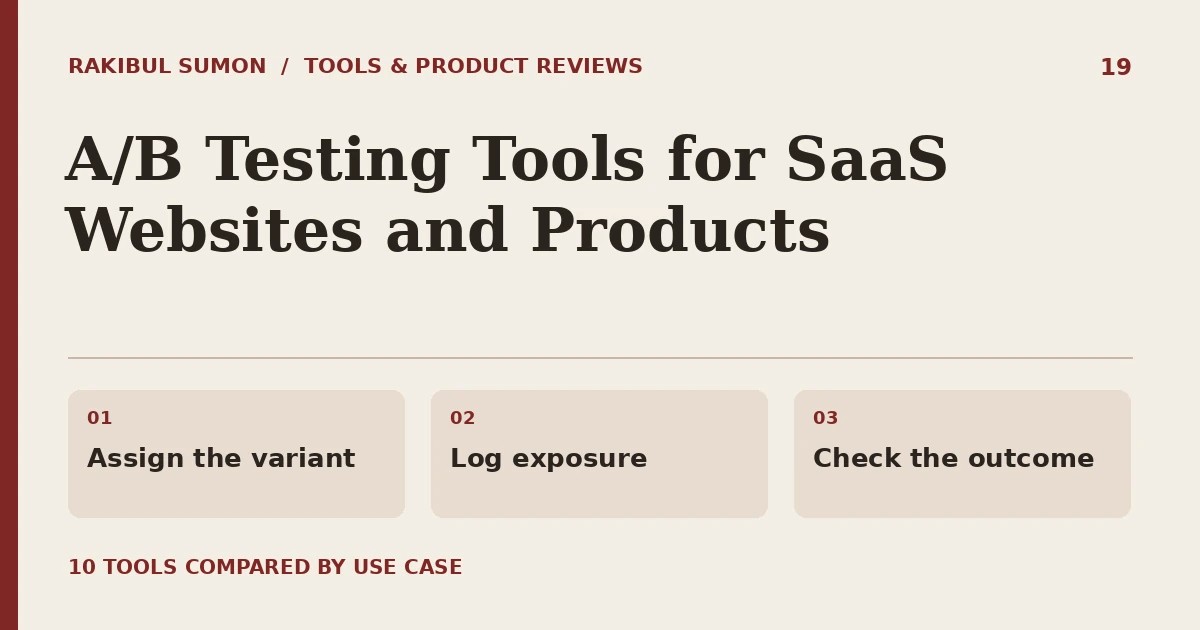
Compare 10 A/B testing tools for SaaS websites and products. Separate campaign testing, feature flags, and analytics-led experiments.
Changing a headline and testing an onboarding rule are different jobs. One can run in a web editor. The other needs a stable assignment, a reliable exposure event, and a rollback that doesn’t depend on the marketing team.
Comparison basis: current public product documentation and a common SaaS buying workflow. Numbering is for navigation. The article does not claim all ten tools were tested in paid accounts.
Run the same pilot before you buy
Run a test with a synthetic user, a returning user, and a user who should be excluded. Check the assigned variant, when exposure is recorded, and whether the same person stays assigned across the surfaces you need.
1. Optimizely
Best fit: A mature experimentation program with dedicated owners.
Consider it when teams already run regular experiments and need governance. Compare its website and feature workflows against the work you actually do.
2. VWO by Wingify
Best fit: Website optimization programs.
Evaluate the current VWO offering if marketers need to change and test a website without routine app releases. Verify support for the specific site framework and experiment surface.
3. Convert
Best fit: Focused website A/B testing.
Try it for a pricing headline or form layout test. Check traffic allocation, preview behavior, and how the platform handles site consent and script loading.
4. Kameleoon
Best fit: Web and product experiments with multiple owners.
Compare it when growth and engineering both need experiments. Pilot one experience in the browser and one in the product before making a shared procurement decision.
5. Statsig
Best fit: Engineering-led experimentation and feature gates.
Look at it if engineers already own feature rollout and instrumentation. Test how exposure and outcomes connect and which team handles metric definitions.
6. GrowthBook
Best fit: Feature flags and experimentation on a data stack.
Consider it when you want control over experiment data and the metric model. Price the implementation time and check warehouse access where relevant.
7. PostHog Experiments
Best fit: Testing near product analytics and flags.
Try it if your event model already lives in PostHog. Confirm whether your success metric and account-level assignment match the way customers use the product.
Growth mechanics, zero fluff.
Join SaaS founders and operators getting weekly notes and tear-downs on organic acquisition and churn reduction.
8. Amplitude Experiment
Best fit: Experimentation near established behavioral cohorts.
Consider it when Amplitude already owns your funnel and retention definitions. Verify exposure rules and how an analyst can explain the numbers.
9. LaunchDarkly
Best fit: Controlled feature rollout and experimentation.
Compare it if a flag already controls the feature and you need measured exposure and outcomes. Test rollback and stable assignment before relying on a live experiment.
10. Crazy Egg
Best fit: A landing page test near heatmaps and replay.
Evaluate it when a marketer wants to move from observed friction to a page test. Verify the setup on your actual pages and check if the available reports meet your measurement needs.
How I’d narrow the shortlist
Use a website experiment tool for the website job and a product flag when the application owns the behavior. If traffic is too low to answer the question, investigate the experience before you buy testing software.
Related workflow: SaaS growth experiment framework.