
Content-led SEO for SaaS

How content-led SEO lowers SaaS customer acquisition cost

Rakibul SumonRakibul Sumon
Published Jul 30, 2026Updated Aug 29, 2026
3 min read
How content-led SEO lowers SaaS customer acquisition cost

TL;DR Summary

Why relying entirely on paid acquisition is a trap for early-stage SaaS, and how building an organic, human-first content engine creates compounding growth and healthy unit economics.

Most founders I talk to solve growth the same way. Spend more on ads. Watch signups go up. Spend more again. Repeat until the numbers stop working, usually around the time the runway conversation starts.

The problem is that paid acquisition never gets cheaper. Your SaaS customer acquisition cost on day 500 looks almost identical to day one, because you are renting attention rather than owning it. Turn the campaigns off and the pipeline goes with them.

Content works the opposite way. It is slower, more expensive up front, and genuinely painful for the first six months. Then the cost per customer starts falling and does not stop. I want to show you what that curve actually looks like, including the part where it looks like a failure.

What CAC actually measures

Customer acquisition cost is what you spend to win one paying customer.

CAC = Total sales and marketing spend ÷ New customers acquired

Simple enough. The trouble is that most teams only track paid CAC and call it CAC. Those are different numbers.

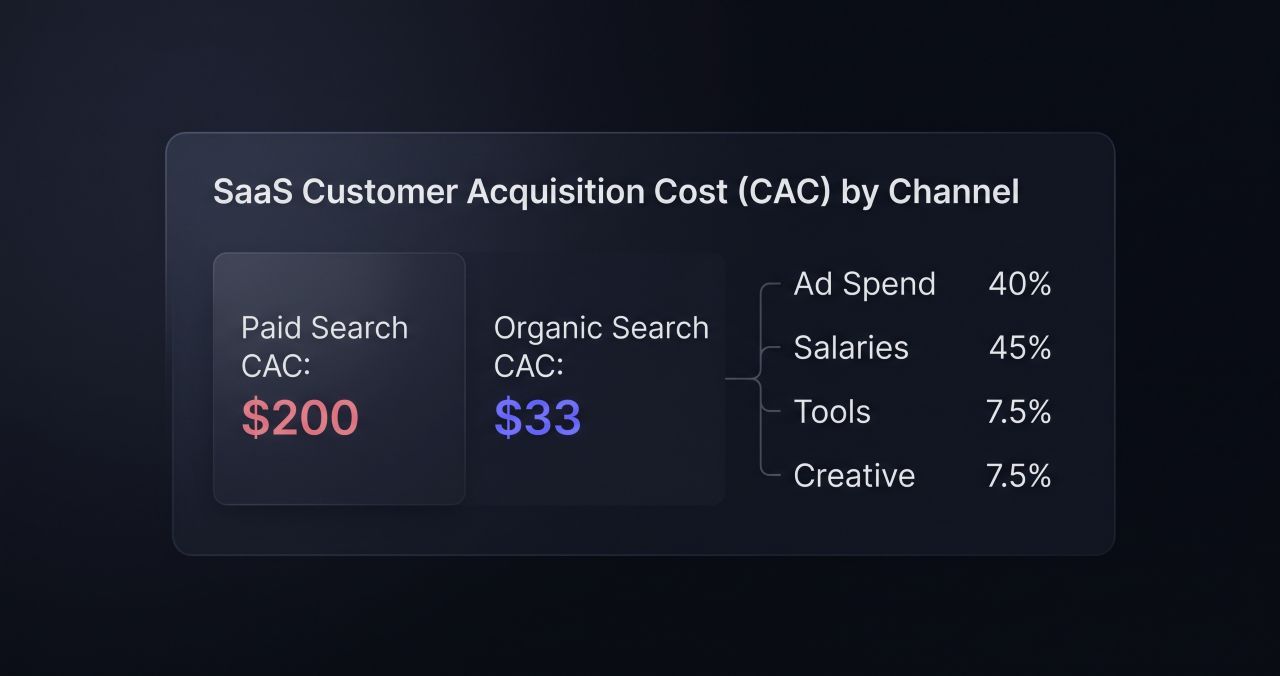
Paid CAC covers one channel. Blended CAC covers everything: ad spend, salaries, tools, contractors, and the content team. Blended CAC is the honest one, and it is the number your investors will eventually ask for.

Two things make CAC useful rather than decorative:

CAC payback period tells you how long a customer takes to repay what you spent winning them. Not in revenue. In gross profit.

CAC payback (months) = CAC ÷ (ARPA × Gross margin %)

LTV to CAC ratio tells you whether the customer is worth acquiring at all. The benchmark is 3:1, meaning every dollar spent comes back as three dollars of gross profit. I broke down the gross margin side of that in my post on SaaS customer lifetime value, and it matters here because a CAC number without an LTV number tells you nothing.

Why paid acquisition stays expensive forever

Run a plausible paid funnel and watch what happens.

You spend $10,000 a month. B2B software keywords cost around $6 a click, so that buys roughly 1,667 visits. Your landing page converts 3% to trial, giving you 50 trials. A quarter of those convert to paid, so 12 customers.

CAC lands at about $800.

Now run it again next month. Same $800. And the month after that. The only things that move it are conversion rate improvements and auction prices, and auction prices move against you as competitors enter.

At $100 ARPA and 80% gross margin, each customer produces $80 a month in gross profit. So an $800 CAC takes 10 months to pay back, and your LTV to CAC ratio sits at 2:1 against an LTV of $1,600. That is below the benchmark. It works, barely, as long as nothing changes. Nothing ever stays unchanged.

This is what I mean by renting users. You are not building an asset. You are paying rent on attention, and the landlord raises it every year.

What content does to CAC over 18 months

Here is the same business investing $5,000 a month into content instead. The numbers below are a model, not a case study, but the shape matches what I have watched happen repeatedly.

Content-led acquisition at $5,000 per month
Month Cumulative spend Cumulative customers Effective CAC
3 $15,000 0 No customers yet
6 $30,000 6 $5,000
9 $45,000 30 $1,500
12 $60,000 84 $714
15 $75,000 174 $431
18 $90,000 294 $306

Paid acquisition holds steady at $800 per customer the whole way. Content crosses under it somewhere around month 12, then keeps falling.

Look at month six. You have spent $30,000 and acquired six customers. Your CAC is $5,000 against a paid channel doing $800. On paper you have set fire to a quarter of a year's marketing budget.

This is where almost everyone quits. The spreadsheet says stop, so they stop, and they conclude content does not work for SaaS.

The crossover happens somewhere between month nine and month twelve. By month 18 the cumulative CAC is $306, and the marginal CAC, what the next customer costs you right now, is closer to $125. Payback drops from 10 months to under two. The LTV to CAC ratio moves from 2:1 to better than 5:1.

That is the whole argument. Not that content is cheap, but that the cost curve points down instead of sideways.

Look at month six. You have spent $30,000 and acquired six customers. Your CAC is $5,000 against a paid channel doing $800. On paper you have set fire to a quarter of a year's marketing budget.

This is where almost everyone quits. The spreadsheet says stop, so they stop, and they conclude content does not work for SaaS.

The crossover happens somewhere between month nine and month twelve. By month 18 the cumulative CAC is $306, and the marginal CAC, what the next customer costs you right now, is closer to $125. Payback drops from 10 months to under two. The LTV to CAC ratio moves from 2:1 to better than 5:1.

That is the whole argument. Not that content is cheap, but that the cost curve points down instead of sideways.

E-E-A-T is now a cost lever, not a checkbox

The model above only works if the content ranks. And the bar for ranking moved.

If your process is to search a keyword and rewrite whatever sits in the top five results, you are producing something Google already has ten copies of. There is no reason to rank an eleventh.

Google's search quality guidelines now weight Experience alongside Expertise, Authority, and Trust. Experience is the one most SaaS blogs cannot fake, because it requires having actually done the thing.

What that looks like in practice:

Publish real numbers, including the bad ones: A post that says "we tried this and it did not work, here is what the data showed" outranks a post that says "here are seven best practices," because only one of them could have been written by someone who was there. Failed experiments are the most underused content asset in SaaS.

Write for a funnel stage, not a search volume number: A keyword with 8,000 monthly searches and no buying intent costs you the same to produce as one with 200 searches from people comparing your product against a competitor. The second one pays. Match content to where the reader actually is: figuring out they have a problem, comparing options, or trying to get set up.

Help the reader make a hard call: The best performing pages I have seen are the ones that reduce a decision to something manageable. A framework, a table, a worked calculation. Not a definition dump.

Connect content to the product honestly: If the article solves the problem and your tool is a reasonable next step, say so once and move on. Readers can tell the difference between a recommendation and a pitch, and so can Google.

Why organic users cost less and stay longer

CAC is only half the picture. The customers content brings you also behave differently.

Someone who found you through a paid ad clicked an interruption. Someone who found you through search was already trying to solve the problem, read 1,500 words of your thinking on it, and decided you were credible before they ever hit the signup button.

That difference shows up in three places. Organic signups activate faster, because they arrived understanding what the product does. They churn less in the first 90 days, which is where most SaaS churn lives. And they need less hand holding from support, which protects your gross margin.

Lower CAC and higher LTV at the same time. That is the loop, and it is the reason the ratio improves faster than the CAC line alone suggests.

How to tell it is working before month 12

The nine month blind spot is the real problem with content-led acquisition. You need signals before revenue arrives, or you will lose the internal argument.

Track these instead of waiting on signups:

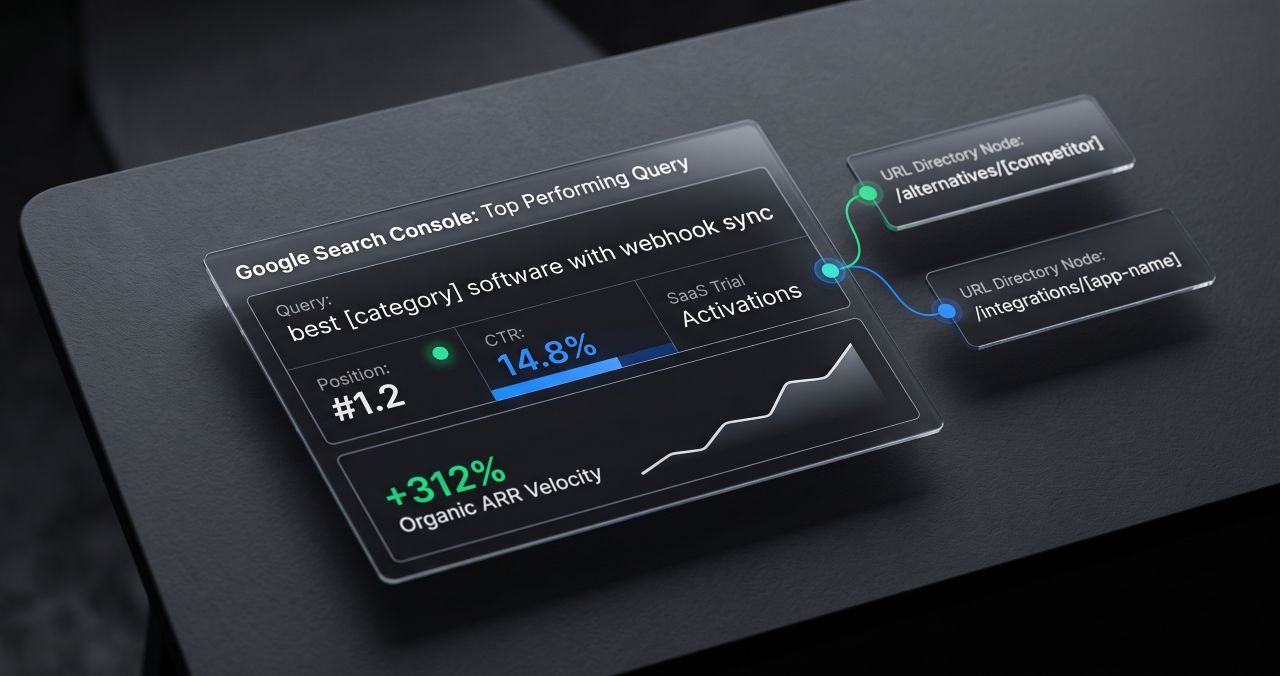
  • Impressions in Search Console: Impressions rise months before clicks do. If they are climbing, Google is starting to consider you for queries you have not won yet.
  • Average position for target terms: Moving from position 40 to position 18 produces almost no traffic and is a genuinely strong signal.
  • Branded search volume: People searching your product name directly means the content is doing brand work the attribution model will never credit it for.
  • Assisted conversions: Check whether organic pages show up anywhere in the path of your paid conversions. They usually do, which means your paid CAC is already being subsidised by content you are not crediting.

Growth mechanics, zero fluff.

Join 2,000+ SaaS founders getting weekly tear-downs on organic acquisition and churn reduction.

  • Time on page and scroll depth on your money pages: Cheap to check, and it tells you fast whether people are actually reading or bouncing.

If those five are moving by month four, keep going. If nothing has moved by month six, the problem is the content, not the timeline.

What keeps content CAC high

  • Publishing without a target query, so nothing has a chance of ranking
  • Measuring cost per article instead of cost per portfolio, which makes every individual piece look like a failure
  • Chasing traffic volume when your buyers are a few hundred people searching narrow terms
  • Leaving pages unlinked, so your best article passes no authority to the page that converts
  • Quitting at month six, which is the single most expensive decision on this list
  • Running content and paid as separate budgets, so nobody notices that organic is already assisting paid conversions

Frequently asked questions

How long before content-led SEO reduces CAC?

Expect nine to twelve months before your blended CAC visibly moves, and roughly 18 before the content channel beats paid outright. Sites with existing domain authority move faster. A brand new domain should plan for the longer end.

What is a good CAC payback period for SaaS?

Under 12 months for most B2B SaaS, and under six months if you are bootstrapped and cash constrained. Anything past 18 months means you are funding growth from cash you do not have yet.

Should I stop running paid ads while building content?

No. Paid keeps the pipeline alive through the months when content produces nothing, and it gives you conversion data far faster than organic will. The goal is shifting the mix over time, not flipping a switch.

How do I calculate CAC for content correctly?

Include everything: writer and editor costs, your own time at a real hourly rate, tools, design, and any promotion. Then divide by customers attributed to organic over the same period, not per article. Content works as a portfolio, and judging individual pieces will mislead you every time.

Does AI-generated content lower CAC?

It lowers production cost, which is not the same thing. If the output is a rewrite of the existing top results, it will not rank, and unranked content has infinite CAC. The parts that create ranking advantage right now are the parts a model cannot produce for you: your data, your failures, your judgment.

Where to start

If your SaaS customer acquisition cost has been flat for a year, more ad spend will not fix it. It will just buy the same customer at the same price until the auction gets more expensive.

Pick five queries your actual buyers search when they are close to a decision. Write the best page on the internet for each one, using your own data and your own failures. Link them to the page that converts. Then check Search Console impressions every month and hold your nerve until month nine.

That is slower than turning up a budget slider. It is also the only version where the cost curve eventually bends in your favour.

If you want to work out whether your current numbers support that timeline, my SaaS unit economics breakdown covers the payback math,.

Rakibul Sumon

Written by · SaaS Growth Marketer

Rakibul Sumon

SaaS growth marketer who learns deeply, experiments openly, and shares results publicly. Focused on content-led SEO, brand positioning, and building growth systems that compound over time.

Learning In Public

SaaS growth insights,_

No hype, no recycled advice - just honest experiments, frameworks, and lessons from the trenches, delivered when there's something worth sharing.

No spam, ever. Unsubscribe anytime.