TL;DR Summary
Sales compensation SaaS plan is 50/50 Base Salary and Sales Bonus as On-Target Earnings. B2B software sales quotas are 4x-6x OTE. They take an 8-12% commission on new net annual recurring revenue, leaving gross margins intact and a fast payback.
Setting up a sales compensation SaaS plan is a tough puzzle for software founders. If you set quotas too high, your best sales reps quit. If you set them too low or pay wild rates, your acquisition cost jumps. That extra cost burns your cash fast.
Over the years, I have seen early startups copy big enterprise pay plans. They do this without checking their own unit economics. They offer flat bonuses on multi-year contract values. Or they hand out big cash payouts without churn clawbacks. Within two quarters, cash runs dry while customer churn climbs.
A good pay plan does more than reward closed deals. It links seller pay to customer retention, gross margins, and lifetime value. In this guide, we walk through the exact formulas, quota ratios, commission tiers, and rules. Here’s how to build a fair pay plan for your sales team.
Core mechanics of a sales compensation SaaS model
The SaaS model for sales compensation is built on three numbers: base pay, bonus pay, and sales quotas. Sales reps get a regular base salary for the everyday sales work. They also get sales commissions on closed deals that result in active software accounts.
OTE is base pay plus target bonus pay. For most B2B SaaS sales reps, the market norm is a 50/50 pay split. That means an AE with a $160,000 OTE gets $80,000 in base pay. They get another $80,000 in bonus pay when they hit 100% of their annual quota.
Pay splits by sale type are determined by who is in control of the deal:
- Sales Development Reps (SDRs): Most reps are on a 70/30 or 60/40 split. They are paid for qualified leads and booked calls — not for closing sales.
- Account Executives (AEs): split 50/50 reps. Their bonus is tied to closed Net New ARR.
- Account Managers and Customer Success Teams work on a 70/30 or 80/20 split. Their pay is tied to net retention, account renewal and expansion revenue.
When we model revenue growth, I always treat the variable pay mix as an operational lever. You can learn more about managing customer acquisition costs in our guide to SaaS Unit Economics.
Setting quota to OTE ratios that protect margins
A quota-to-OTE ratio shows how much new ARR a sales rep must close for each dollar of on-target pay. For B2B SaaS, a typical annual quota is 4x to 6x total OTE (The Bridge Group, 2024).
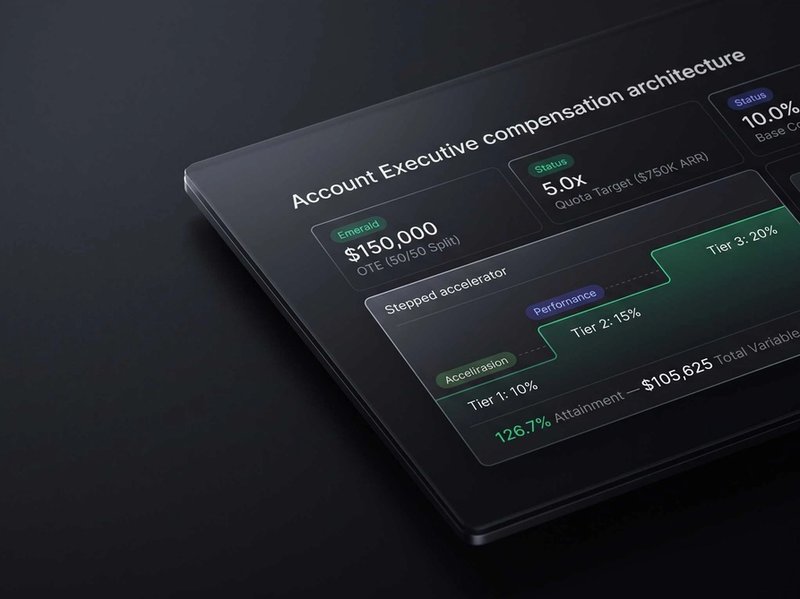
Say an account executive has an OTE of $150,000. That’s $75,000 in base pay, and $75,000 in bonus pay. A 5x quota target means they have to close $750K in Net New ARR each year. So this 5x multiple gives us a base commission rate of 10%:
Base Commission Rate = Target Variable Pay / Annual Quota Target
Base Commission Rate = $75,000 / $750,000 = 10.0%
Quota-to-OTE Multiples and Margin Impact
| Ratio Multiple | Annual OTE | Required Quota | Base Rate | Risk Profile & Context |
|---|---|---|---|---|
| 3x (Low) | $150,000 | $450,000 | 16.7% | High CAC risk; only fits high-price enterprise deals |
| 4x (Moderate) | $150,000 | $600,000 | 12.5% | Standard for mid-market SaaS with 60-day sales cycles |
| 5x (Target) | $150,000 | $750,000 | 10.0% | Best balance: Sustainable rep pay and fast payback periods |
| 6x+ (Aggressive) | $150,000 | $900,000 | 8.3% | Fits fast inbound SaaS with high-velocity deal cycles |
Ratios under 4x inflate the cost of sales. They stretch CAC payback times past 18 months. When setting your quota targets, cross-check your team conversion rates with our SaaS Metrics Guide.
Structuring tiered accelerators for top sellers
Tiered accelerators raise the commission rate on each new dollar closed once a sales rep passes 100% of quota. Accelerators give top sellers a strong reason to keep closing deals late in the quarter. Reps do not hold back deals for the next cycle.
A typical stepped accelerator pays higher rates at three different levels:
- Tier 1 (Up to 100% Quota): Base commission rate of 10.0%.
- Tier 2 (100.1% to 125% Quota): 1.5x tier rate of 15.0% commission.
- Tier 3 (Above 125% Quota): 2.0x tier rate of 20.0% commission.
Payout math example: For an AE with a $750,000 quota and $75,000 variable target who closes $950,000 in Net New ARR (126.7% quota attainment):
- First $750,000 (100% quota): $750,000 * 10% = $75,000
- Next $187,500 (100% to 125%): $187,500 * 15% = $28,125
- Remaining $12,500 (Above 125%): $12,500 * 20% = $2,500
- Total Variable Commission Paid: $105,625 compared to the $75,000 base target.
Accelerators only apply to new dollars above each tier. Never apply higher rates back to the first dollar of sales. Retroactive accelerators cause big cost jumps. Those jumps can wipe out your deal profits.
Rules for multi-year deals, cash collections, and clawbacks
A safe sales pay plan sets clear rules for multi-year contracts, cash collections, and early customer churn. Without clear rules, reps may close weak, long-term contracts with bad-fit clients just to collect quick commission checks.
Public company records from the U.S. Securities and Exchange Commission filings show that public SaaS firms spend 40% to 50% of revenue on sales and marketing. To make sales costs predictable, your pay plan should follow 3 core rules:

- Pay commission on first-year ARR, not total contract value: Always pay standard commissions on first year Annual Recurring Revenue (ARR), not Total Contract Value (TCV). If an AE closes a 3-year deal worth $300,000 ($100,000 ARR per year), pay commission on the value of the first year ($100,000). If you want multi-year deals, offer a small 1% to 3% cash bonus on years two and three instead of full commission rates.
- Use a 60 to 90 day clawback window: If a new client cancels, fails setup, or asks for a refund within the first 60 to 90 days, take back the unearned commission from the rep's next check. This rule stops reps from closing bad-fit buyers who churn right away.
- Tie payouts to cash collection: Pay half the commission when the deal is signed. Once the client has paid their first invoice, pay off the remaining balance. This policy ties sales incentives directly to real business cash flow.
Step-by-step framework to build your sales compensation SaaS plan
SaaS Plan Building Your Sales Compensation The SaaS plan has five different calculation steps that keep earnings, quotas and business goals in balance:
- Step 1: Calculate role OTE from market benchmarks. See U.S. Bureau of Labor Statistics for typical pay ranges for your area and position, which has valid data. Choose the right pay mix (e.g., 50/50 for AEs)
- Step 2: Annual quota from target multiples. Multiply total OTE by your target multiple (e.g. 5x So for example, $140,000 OTE x 5x = $700,000 annual quota.
- Step 3: Find base commission rate. Determine the base commission rate. Variable pay / annual quota ( $ 70,000 / $ 700,000 = 10 % ).
- Step 4: Set tiered accelerators and cliff rules. Accelerators, and cliffs. Added accelerator tiers upon 100% quota attainment. Or maybe you want a 50% quota cliff for new reps in ramp up so they have a clear baseline target.
- Step 5: Test edge cases in your financial model. Stress-Testing Your Financial Model. Have your team test best-case, expected and low-case sales scenarios. Make sure total sales commissions stay within 8% to 12% of total new revenue. You can find more templates and checklists in our library of SaaS Growth Resources.
Strategic trade-offs and edge cases in sales pay plans
Growth mechanics, zero fluff.
Join 2,000+ SaaS founders getting weekly tear-downs on organic acquisition and churn reduction.
Every sales compensation plan involves trade-offs between simplicity, cash flow safety, and individual seller drive. No single pay plan fits every stage of startup growth.
Key trade-offs to evaluate:
- High Base vs High Variable: Early startups with no good product market fit should be doing 60/40 or 70/30 splits with lower quota. Reps test pitch scripts, source leads, don't close warm inbound deals. As demand for the product increases, move to a 50/50 split.
- Capped vs Uncapped Commissions: Don’t cap commissions for top sales reps. Cap on earnings is an artificial earnings ceiling. It prevents your best sellers from closing out when they hit a target. Instead of hard caps, protect profit with tiered margin math.
- Team vs Individual Quotas: Individual quotas have direct ownership for outbound reps. Team bonuses are more effective for sales engineers and onboarding specialists who assist in concluding complex group deals.
If you’re testing a new pay plan, run structured Growth Experiments to measure your results before rolling the change out to the whole team.
Frequently asked questions
What is the average quota-to-OTE ratio in SaaS?
The average quota to OTE ratio for B2B SaaS is between 4x and 6x with 5x being the standard benchmark. Mid-market software companies with deal sizes of $20k-$50k are typically aiming for 5x. Enterprise teams that work with long sales cycles often run around 4x, whereas self-serve products can be 6x or higher.
Should SaaS sales commissions be based on ARR or total contract value?
SaaS sales commissions should be paid on first-year Annual Recurring Revenue (ARR) not Total Contract Value (TCV). Multi-year deals take cash out of your pocket before you get revenue, at full commission rates. If you want to do multi-year deals, offer a bonus of 1 to 3% for the future years, not full commission rates.
What is a commission clawback in SaaS contracts?
A commission clawback allows a company to recoup commissions paid out when a customer cancels or defaults within a period of time, often between 60 and 90 days. The unearned amount is deducted from the rep’s next commission check, protecting the company from bad-fit accounts.
What is the difference between a spiff and an accelerator?
An accelerator is a permanent tier in your pay plan that bumps up commission rates once a rep hits 100% of quota. A spiff is a short-term cash bonus paid for quick goals, like booking five demo calls in one week or closing a new add-on feature.
When should a SaaS startup hire its first account executive?
An accelerator is a permanent tier in your pay plan that bumps up commission rates once a rep hits 100% of quota. A spiff is a short-term cash bonus paid for quick goals, like booking five demo calls in one week or closing a new add-on feature.
Conclusion and next steps
Building a strong sales compensation SaaS plan takes clear math and close alignment with your unit economics. You win by building a system that rewards both your reps and your business, with a balanced 50/50 OTE split, 4x-6x quota ratios, and progressive accelerators for top performers.
If you’re reviewing your team’s pay plans today is a good day to audit your current payback times and quota hit rates. For definitions of key metrics, check out SaaS Growth Glossary.