

TL;DR Summary
BOFU SEO targets buyers already choosing between named tools. The page template I use, the conversion math behind it, and the legal limits on naming rivals.
For five months, I prepared general guides covering team workflows, daily habits, and fundamental definitions, and Search Console showed excellent results, with organic traffic reaching thousands of visits per month.
Yet when I looked at the billing dashboard, there were no new paying customers.
At first I assumed that traffic meant demand, but that is not the case. Those who are looking for definitions usually only need a slide for a meeting, not a product trial. That is why I stopped focusing on traffic volume and started focusing on buyers. Here are the things I have learned since then, along with my mistakes.
BOFU SEO means creating content for people already considering specific products; their searches focus on comparisons, alternatives, pricing, and different use cases. Although these pages receive less traffic than guides, readers are more likely to start a trial or book a demo.
Why my high-traffic guides never produced a customer
The guides and the buying pages draw in different groups of people, and the difference in new signups is considerably greater than most keyword tools indicate. That was my major error.
The clearest public data available is from the Grow and Convert agency, which monitored signups by keyword type across 95 client articles. These articles generated 123,000 organic pageviews and resulted in 4,687 product conversions over six months. The results by tier are shown below.
| What the searcher is doing | Example query | Visitor-to-lead rate |
|---|---|---|
| Reading up on a topic | what is lead capture | Under 1% |
| Solving a task today | how to export leads to a CRM | 2.44% |
| Shopping the category | best time tracking software | 4.85% |
| Weighing two finalists | Asana vs Monday | 5.45% |
| Leaving a tool they dislike | Salesforce alternatives | 8.43% |
If you work out the figures for yourself, you'll soon notice the difference. For instance, if it costs $800 to research and rank a guide and it generates 4,000 visits a month with a 0.5% sign-up rate, then you get 20 trials.
Consider a comparison page that receives 200 visits with a 6% sign-up rate; that will give you 12 trials from just a small part of the traffic. The amount of writing required is the same, but these visitors already have a budget.
Here's an honest warning: the headline figure may be misleading. Grow and Convert found that most of the 23 alternative posts in their study had a conversion rate below 4%. The average of 8.43% is higher because some pages targeted very close competitors. While the ranking of the results is correct, do not expect all alternative pages to achieve 8%.
Regarding the spreadsheet, I set out the cost calculation separately in my notes on SaaS unit economics and CAC payback.
The four BOFU page types that catch buyers mid-shortlist
There are four kinds of pages that deal with almost all the questions buyers have at each stage of the B2B software buying process—those which look at competitor alternatives, head-to-head comparisons, category pages focused on a particular vertical, and pages relating to pricing or migration—and each of these page types responds to a different question that buyers have.
Pages that feature alternative products. These target people who are currently using another product and would like to switch, typically after a price increase or a failure of support. Search queries in this case look like "[competitor] alternatives" or "tools like [competitor]".
Don't produce balanced overviews that laud every tool; instead, make it clear how the other tool performs well, where it falls short, and what kind of workflow your product is best suited for. When you refer to a competitor that is only weakly related, anticipate a lower signup rate because the searcher's needs will not closely match your product.
Pages that compare products directly. In the case of a search for "[you] versus [competitor]", the person is deciding between two options and wants to know about limitations regarding features, the gaps in integration, and the available export formats, not about marketing terminology. Screenshots help, and it is useful to note the team size for which the other tool is a better choice.
The category and vertical pages. For example, people searching for 'CRM for real estate agencies' know precisely what they are looking for; the page should cover custom fields, compliance rules, and the actual setup time.
This is essentially a positioning exercise with an emphasis on SEO, which is why I leave my notes on brand positioning and messaging available as I write these pages.
The pages relating to pricing and migration. When someone is setting up a budget line, you need to publish your tier limits, the minimum number of seats, and any conditions that trigger an upgrade.
Also include migration information such as file formats, the time taken for the import, and whether assistance will be offered with the process. Focus more on the number of deals that will have to switch stops than on price.
The bottom-of-funnel page template I use now
At this stage, a page that results in a conversion addresses the questions buyers raise, in the order they raise them. The five sections I use, and why each one matters.
1. The verdict, up top. Add two statements below the main heading to indicate which tool is most suitable for each situation. Buyers who are using their phones won't scroll through twelve paragraphs to find your answer.
2. A feature table with five to seven rows. When comparing the features most important to the purchase—such as API access, seat limits, export formats, and CRM integrations—avoid too many checkboxes, since they create clutter.
3. Three or four teardowns of the workflow. Select the main areas of friction between the tools and explain them, referring to the settings menu and stating how long syncing takes. Only by including these details can you show the page is based on testing rather than marketing copy.
4. Make it clear what your own limitations are. For example, if you don't provide enterprise single sign-on or if your reporting is only available for ninety days, say so.
It may seem risky to be this honest, but it isn't. In fact, it stops people from signing up only to leave after the second month and makes the rest of your page appear more believable.
5. The migration path and one call to action. Outline the migration process and include just one request—either a trial or a demo, not both.
Google's advice on writing high-quality reviews supports this approach. It suggests you should look at similar alternatives, explain what makes a particular item different from its competitors, and, based on original research, discuss the advantages and disadvantages. This matches blocks two to four.
To find out how this book fits into the overall publishing strategy, refer to my framework for content-led SEO in SaaS.
Three patterns worth stealing
Now I need to be careful here, since I can't share client figures and would prefer to show you the general approach rather than invent a case study. The patterns are therefore described as scenarios, using the benchmark ranges mentioned above rather than results I can't share.
A bootstrapped tool is trying to reduce competitor churn. For example, suppose you are selling a Chrome extension that competes with older desktop software and can't outbid the established company when running ads.
Rather, you release six to eight alternative pages, each concentrating on a different legacy tool. Each page tackles a particular pain point, for example, the need to handle CSV files manually or the requirement for a minimum number of seats. Each term receives between 150 and 300 searches per month. Given the earlier tiers, pages that compete closely with yours could have a conversion rate ranging from 4% to 8%, while less related pages convert at a lower rate.
A mid-market platform that stopped writing about culture. Consider a project management company with about fifty employees that used to write about workplace culture but now doesn't. In that case, there's no customer pipeline, and the answer lies in editorial work, not technical changes.
They produce around twenty comparison pages, each one honestly indicating where the competitor has the advantage; as a result, when customers come to the demo, they already know the differences between the features, so the conversation begins with objections rather than simple questions.
Vertical software in a crowded category. Software that is vertical within a highly competitive field; although QuickBooks holds the generic accounting-related keywords, you won't be able to secure those. However, it is possible to target 'HIPAA compliant billing software for private clinics', and the person looking for it has a deadline. You could receive eighty visits a month, which is acceptable because these pages offer annual contracts rather than $19 seats.
The experiments I can provide in full fall into growth experiments and analysis.
The three numbers I actually track
Since pageview graphs tend to mask poor-performing pages, I track three things for each BOFU page.
Blended conversion rate: For product-led SaaS, split the blended conversion rate into two parts: session to trial, then trial to paid. The blended conversion rate is calculated by dividing the number of new paying accounts by the number of unique organic sessions and then multiplying by 100.
When the ratio of sessions to trials falls below about 3% on an alternatives page, the issue is usually poor copy or a signup button positioned too far down the page.
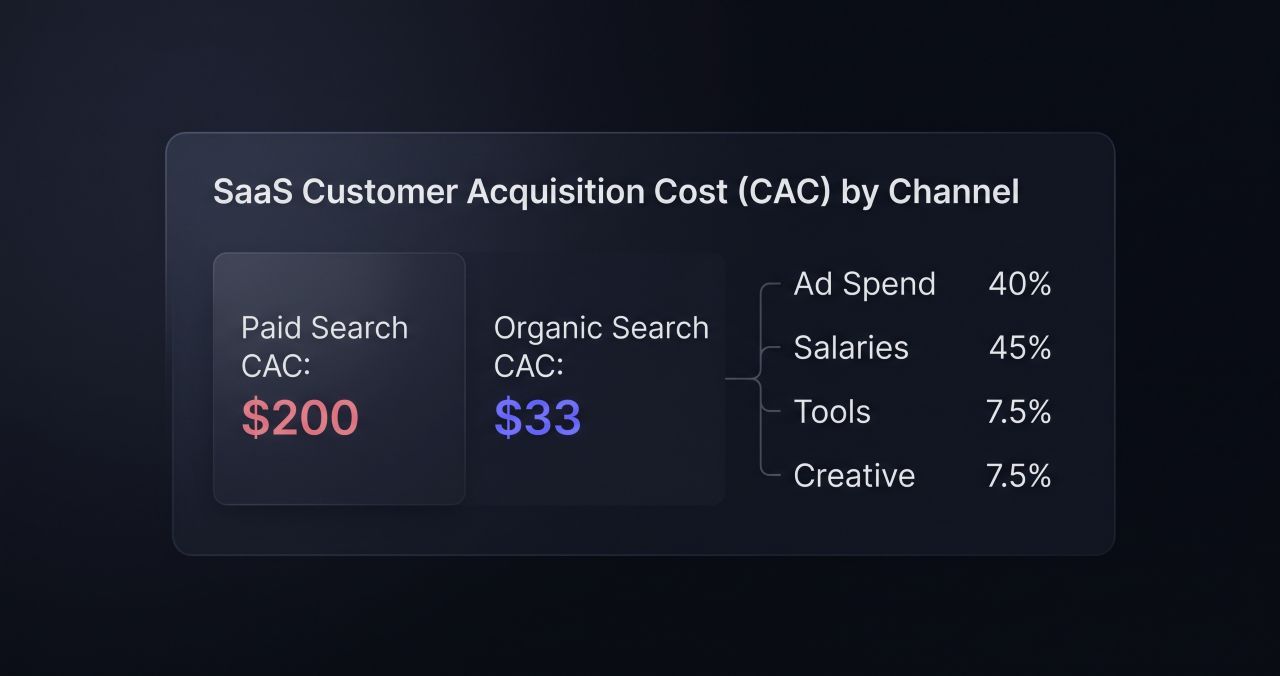
CAC payback: CAC payback equals total acquisition cost divided by average revenue per account multiplied by gross margin. The cost structure shown here is unusual, since the expenditure consists mainly of one-off writing costs plus a quarterly update rather than a monthly advertising bill.
Giving greater attention to the pages related to the buying stage reduced my payback period. Since I've only been collecting this data for a few quarters, regard it as a general trend rather than a standard. The method is included in my SaaS metrics guide.
Pipeline velocity: The pipeline speed is calculated by multiplying the number of qualified opportunities by the win rate and the deal size, then dividing that figure by the sales cycle length in days. You can improve this figure indirectly by using comparison pages.
Gartner research on B2B buying shows that 75% of buyers now prefer to buy without a sales representative present. The same research indicates that buyers go back and forth across six buying tasks rather than completing them in sequence. Since most of the evaluation takes place in your absence, your page must fill the role a sales rep usually plays.
In order to examine the revenue aspect of these formulas, begin by working out the true customer lifetime value.
Where BOFU SEO gets you into trouble
Three problems occur each time, and two of them are legal.
The naming of competitors: In the United States, it is generally lawful to name a rival on the grounds of the nominative fair use doctrine, as the Ninth Circuit stated in the case of New Kids on the Block v. News America Publishing in 1992.
Growth mechanics, zero fluff.
Join 2,000+ SaaS founders getting weekly tear-downs on organic acquisition and churn reduction.
The test consists of three requirements: you must use the term to name the product, you must use no more of it than is necessary, and you must ensure that there is no suggestion of sponsorship. The FTC's policy statement on comparative advertising (16 CFR 14.15) goes further by stating that the Commission encourages referring to competitors, provided the comparison is clear and non-deceptive.
Don't use their logo for decorative purposes and make it clear that you have no association with them. Although I have a law degree, I would still refrain from producing a comparison page for a major competitor without first having a lawyer go over it.
In the EU, Directive 2006/114/EC sets the conditions, and a comparison may be made as long as it is not misleading and the products involved meet the same need. The comparison must refer to features that are material, relevant, verifiable, and representative, and must not damage the competitor's position.
The term "verifiable" is the one that fools people; if you claim your rival is slower, you must provide the test.
The low volume trap: The problem with low search volume: for most specific comparison terms, your keyword tool will show either zero or ten searches per month, after which many marketers give up.
Tools tend to underreport long-tail demand, and AI answer engines do the same. My simple rule is that if a sales representative has answered the same comparison question twice within a month, you should still write the page.
Scoring yourself a perfect ten: It's easy to recognize a perfect score, and such a thing destroys the trust you've established on the page. Be honest when a rival is the better option.
If you're making a product aimed at teams of under twenty people, then you should advise large companies to look elsewhere; although you may lose a small number of signups, you will gain the trust of all the rest.
Frequently asked questions
What is the difference between BOFU SEO and regular content marketing?
BOFU SEO targets people who are ready to make a decision, so it focuses on comparisons, alternatives, pricing, and specific use cases. While most content marketing aims to build early awareness, both methods have their place. The error lies in using the same metrics to evaluate BOFU SEO as are used for general content marketing.
What level of search volume is sufficient to warrant the creation of a bottom-of-funnel page?
You won't need much; twenty to fifty searches a month are usually sufficient since the intent is strong, and it's easier to rank for these terms than for broad category ones. The best indicator is whether the question comes up frequently during sales calls—if it does, produce the page.
Can a new site rank for competitor alternative keywords?
Often, yes. These keywords are less competitive than broad ones. Winning pages usually have more hands-on detail and clearer tables than those above them. Original testing matters more here than domain authority.
How frequently should comparison pages be updated?
Updating once a quarter is a good minimum, since competitors release new features, change pricing, and retire plans. If your page shows last year’s pricing, it hurts you twice: it misleads readers and shows that no one is keeping the site up to date.
Should I include competitor rates?
Include your competitors’ public entry-level prices, and mention where enterprise pricing requires a quote. Buyers are building a budget and will find the number anyway, so getting it wrong is the real risk. Add the date to the figure and check it during your quarterly update.
Your next three comparison pages
Three things matter most. Write for queries where the reader is already making a choice. Be honest so your praise is meaningful. And measure signups, not just sessions.
BOFU SEO takes longer than you expect. Rankings for competitor terms change over months, and your first page will likely be your weakest.
Start this week by reviewing your last ten sales call recordings and noting the three competitors that come up most often. Write one comparison page for the closest of those three, using the five sections above. Check that page’s trial conversion rate in sixty days, and see if it beats your blog average.